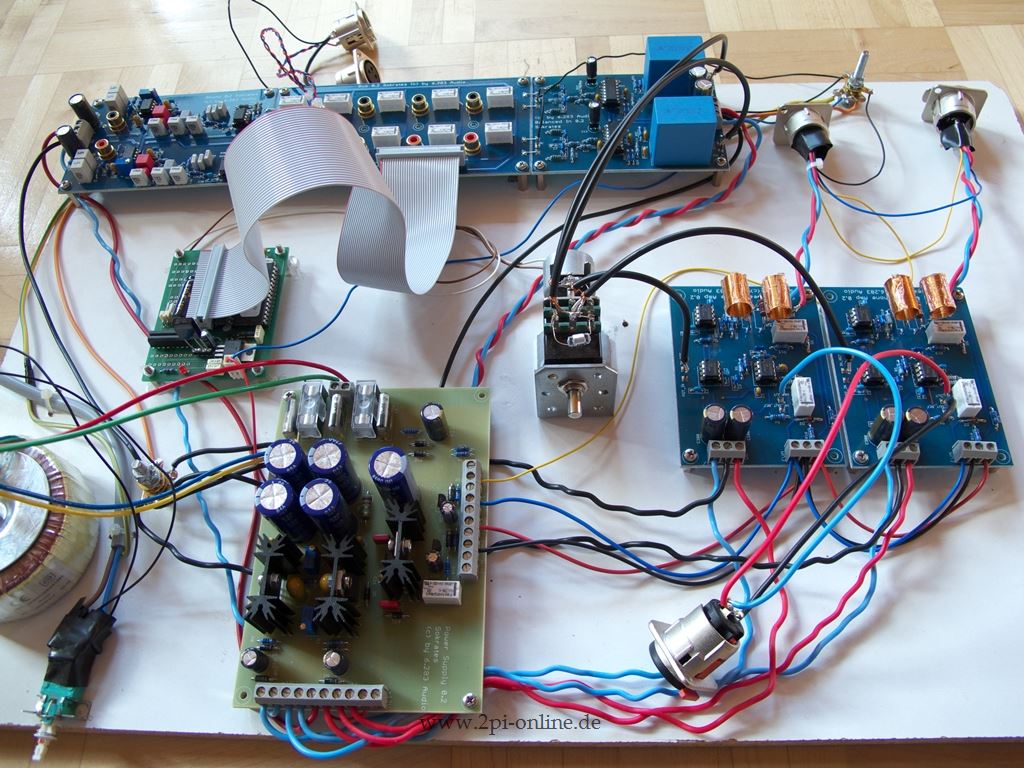
|
Primary Design Goals:
- remote source selection for 5 or more balanced or unbalanced devices and remote volume control
- sustainable elimination of hum in the system
Material and Method:
The input stage features bootstrapping of the common mode signal, which increases the common mode impedance "on demand" so to speak while the differential impedance is kept comparably low to avoid excessive Johnson noise. It has to be mentioned, though that regardless of the bootstrapping, resistor value selection is still crucial as with any other active balanced input without transformer. 1% off the bin is not good enough for a really high CMRR. And even components with 0.1% tolerance can and must be carefully matched. For that I used a simple Wheatstone bridge and a millivolt meter with 0.1mV resolution. The bridge was battery powered (four 9V blocks in series) to obtain a rather high and ripple free voltage.
The balancing has to happen in an environment with constant temperature, especially for resistors, say greater than 5KW.
The input as well as the output stage are built with OpAmps. Within reasonable limits, it is possible to connect source devices with balanced and unbalanced outputs. The ASP of the speakers are hosting the corresponding active balanced input stages, which are virtually identical to those of the pre-amp.
Why not simply using audio transformers and be done with this ? Because the good ones seem to be unobtanium here. But I will keep looking. However, there is no urgency as the current solution is working well.
Sokrates contains a simple but effective phono pre-amp that can be replaced by a different one if desired. It drives a Denon DL-110 high output MC cartridge of a Denon DP-37F turntable.
The device also features a headphone amp made up from two OpAmps per channel to drive a Sennheiser HD650 with 300 Ohm impedance.
The volume is regulated by a high quality motor pot. This can be easily replaced by even better gear such as a switched resistive ladder if I feel like doing so. The input selection is implemented using high quality relays. The remote control and the associated controller board is an off-the-shelf solution.
No caps are required to block DC in the signal path of the pre-amp, except to protect the headphones, the pot and the MC cartridge.
All the caps are lowest distortion PP (Polypropylene) or PPS (Polyphenylene Sulfide) types with appropriate tolerances. The small capacitances in the feedback paths of the OPamps are C0G/NP0 multilayer ceramics also with lowest distortion.
Rev. 0.1 was built with OPA134 / OPA2134 but rev. 0.2 will be based upon LM4562 and the corresponding single and quad OPamps (LME49710, LME49740). The phono amp will feature one of the best in voltage noise class: BJT OPamp AD797.
Status of the project:
30-Jan-2013: All functional blocks have now been verified and validated.
13-Mar-2012: Version 0.2 is up and running and everything works as desired.
First things first: Hum is no issue as was with rev. 0.1.
Did the LM(E) OPamps change the sound ? That cannot be answered clearly because too many other variables changed at the same time, e.g. the output stage, the layout of the grounding scheme, and the entire power supply. In total, version 0.2 sounds a pinch warmer and more relaxed, especially the highs, and it has a notch more cleanness and smoothness. I think that this is simply the result of less distortion above 2KHz and the lower voltage noise density of the LM(E) BJT OPamp family compared to the FET OPamp.
The completely re-designed phono stage also works well. The gain had to be increased from 100 to 110 so that the level difference is minimized when switching sources. At this high gain (40.9dB) the AD797 has no issues whatsoever driving the capacitive load imposed by the RIAA network.
The noise contribution of the phono stage is really minimal. You can only hear very little hiss when you hold your ear right against the speaker membrane. On the other hand I am very happy with the high output (1.6mV) of the Denon MC cartridge, which makes it possible to go with only one gain stage.
I do not own many LPs anymore (or not yet ?). But one of the few I have is also present as a CD so I can directly compare them. With this album (FGTH - Welcome to the Pleasure Dome), the CD has more clarity in the mids and highs. If I don't switch back and forth I don't miss a thing, though when listening to vinyl only.
The air core coils of the output stage have become much bigger than calculated. Even a safety margin was eaten up soon so that the boards look a bit like space ships (not Klingon this time).
As a bottom line, the work has paid off. All the changes are positive, especially the improvement in cleanness and smoothness. But latter is nothing compared to what different speakers with their radiation pattern can do in a room J .
Related Literature:
- JAES (Journal of the AES), Volume 43 Number 6, Special Excerpt “Shields & Grounds: Safety, Power Mains, Studio, Cable, Equipment”.
This collection of papers is a highly recommended reading !
- Douglas Self, Small Signal Audio Design, Focal Press, 2010
- Op Amp Applications Handbook, Walter G. Jung, Analog devices, 2002
|